

Shot Peening Media Qualification for Springs and Gears
Choose peening media from the spring or gear process specification, then qualify the supplied particles and the treatment separately. Material, size, hardness and particle condition belong with incoming acceptance; intensity, coverage and treated areas belong with the operation. This guide helps you preserve those connections when evaluating a candidate or changing a source.
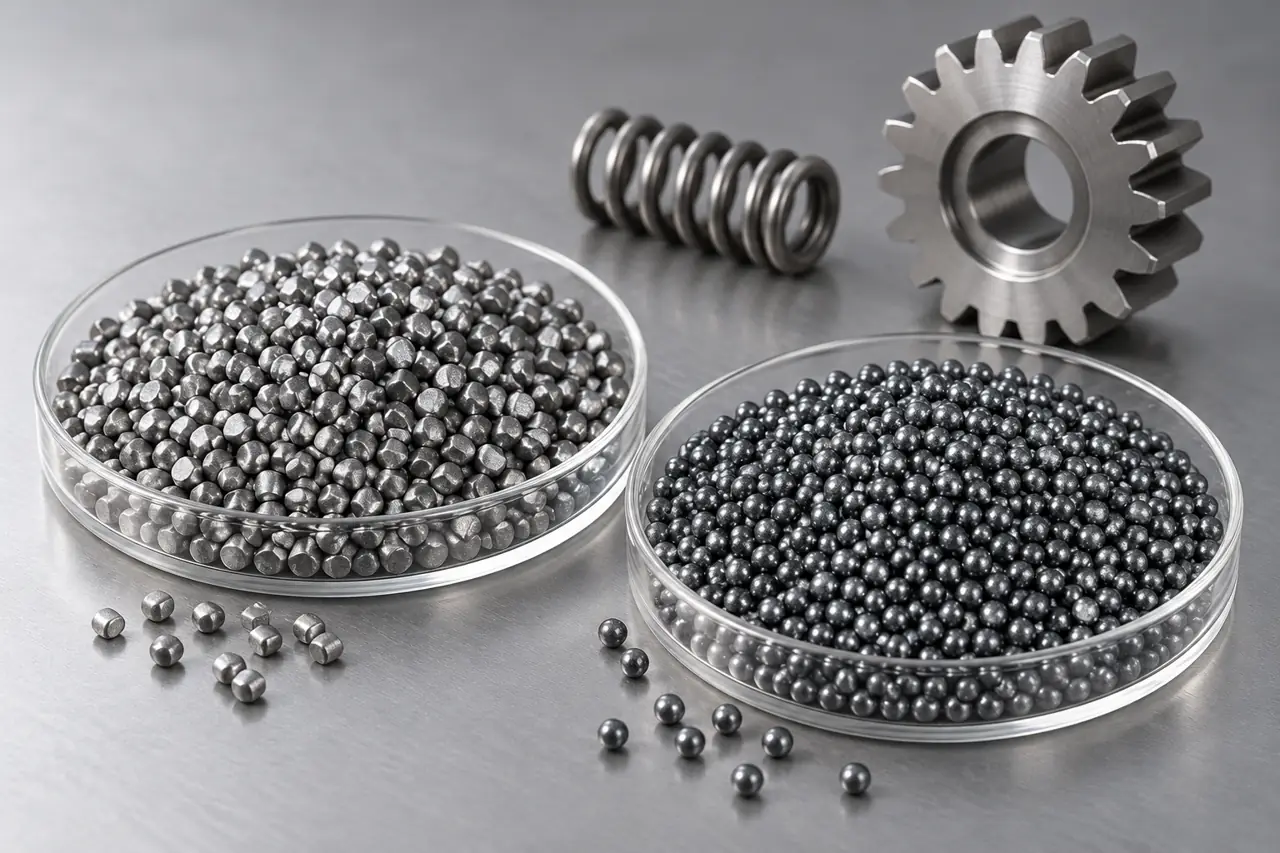
Separate the peening acceptance decisions
For springs or gears whose drawing specifies shot peening, select the media standard, material, size, hardness and particle condition from that process requirement before comparing suppliers. A cleaning-grade abrasive and a round-looking sample do not qualify a fatigue-critical treatment. Relia can discuss its cast-steel-shot production and a separately defined carbon cut-wire supply candidate. Approve incoming media identity and the peening process through different evidence: particle inspection supports the supplied material, while intensity, coverage and treated-area records support the operation. Send the component specification and existing qualified-media reference so the proposed candidate has a clear acceptance boundary.
- Media requirementSelect material, size, hardness and particle condition from the actual process specification.
- Operating controlsUse the required intensity, coverage and treated areas for the named component.
- Qualification evidenceConnect incoming particle conformity with the recorded treatment without treating them as interchangeable proof.
Selection context and decision detail
| Buyer requirement | Relia response | Evidence or condition |
|---|---|---|
| Drawing-controlled media | Discuss cast-shot and listed cut-wire candidates | Exact class, condition and process specification required |
| Production evidence | Own cast-shot route and batch inspection records | Cutting/conditioning responsibility defined separately |
| Peening approval | Provide a defined candidate for technical evaluation | Intensity, coverage and component release remain process decisions |
Cast shot manufacture and cut-wire supply have different scopes
Keep confirmed cast shot production distinct from the producer and conditioning scope of cut wire.
Relia manufactures cast steel shot through in-house melting, atomization, heat treatment and grading. Our incoming, process and final inspection stages are confirmed, and corresponding batch records can be provided. Match the selected cast-media evidence with the peening specification's characteristics.
Carbon cut-wire media is a separate listed supply route. Its cutting and conditioning operations are not established as in-house by our cast-shot capability. The offer must identify the producer, selected wire material, particle condition and applicable evidence for the cut-wire candidate.
- Cast shotOwn cast-abrasive production route
- Cut wireProducer, cutting and conditioning to identify
- InspectionCorresponding batch records for defined characteristics
As-cut cylinders are not proof of a conditioned peening particle
Visible cut faces describe a candidate form rather than proof of conditioned peening particle compliance.
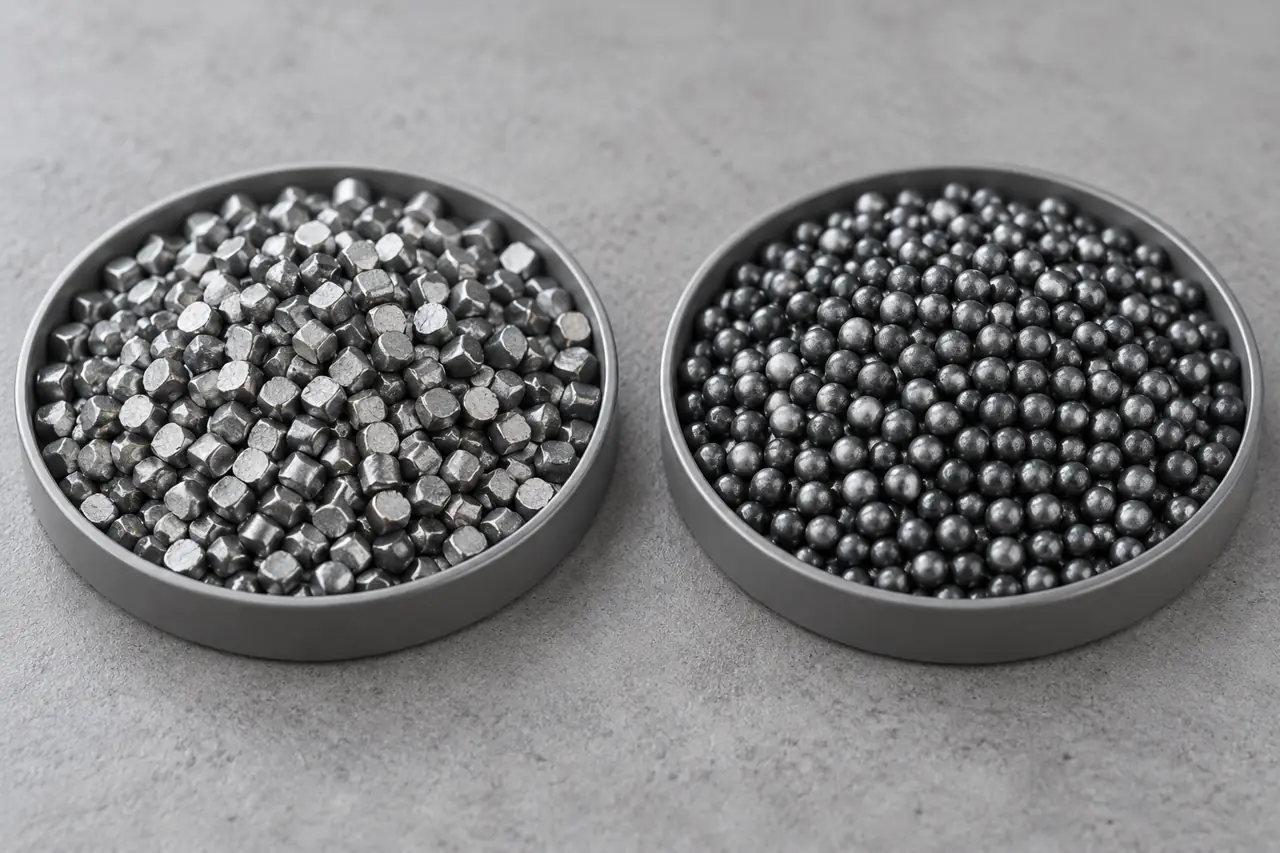
Distinguish candidate particle conditions
The carbon cut-wire listing describes cylindrical particles and 42–53 HRC, with CW0.6 through CW2.5 labels and independent diameter selections from 0.6 to 2.5 mm. Confirm the intended pairing and any required conditioning. Cut faces and edges affect contact; conditioning changes that geometry.
The cast-shot reference also gives 42–53 HRC but has broad grading and mixed-shape fields. Neither entry establishes your required peening-media class. The AI-assisted pictures show visibly cut-faced candidates beside rounded shot; they illustrate a selection distinction, not demonstrated compliant conditioned media.
- As cut cylindersCut faces and edges remain part of the contact geometry requiring review.
- Conditioned cut wireSpecified prerounding needs evidence for the actual particle population being offered.
- Cast steel shotConfirm the required form and condition against the peening media specification independently.
Product references for your shortlist
Open the product details, then discuss the exact specification for your application.
Cast shot peening enquiry
A cast media candidate to review against the exact particle requirements of an existing spring or gear peening specification.
Carbon cut wire peening enquiry
A separate candidate route when the process specifies cut wire with an explicit supplied particle condition.
Particle control links production to surface treatment
Read distribution, shape, structure and hardness as separate parts of the incoming particle requirement.
Cast-particle formation and heat treatment influence structure, hardness and breakdown; grading limits the population entering the stream. For cut-wire media, starting wire identity, cut geometry and the specified conditioning determine a different particle route. Keep these characteristics separate in incoming acceptance.
A size-distribution result cannot establish absence of sharp particles, and a hardness value cannot establish the whole population's shape or defects. Request the relevant batch evidence against the component's media specification, including the stated sampling and method scope, without assuming every listed item is inspected by one universal routine.
- MaterialAlloy or steel identity
- PopulationGrading and particle-condition limits
- Batch evidenceMethods, sample and results
- Process releaseSeparate qualified operation
Intensity and coverage answer different process questions
Derive and assess intensity and coverage separately under the applicable qualified process.
SAE J443 addresses deriving and verifying peening intensity. SAE J2277 addresses coverage and its relation to exposure. Increasing exposure time is not a substitute for establishing the required intensity, and either insufficient or excessive coverage can be harmful.
Use the drawing's intensity range, treated areas, exclusions and required coverage assessment. Record actual machine conditions, media condition and monitoring evidence under the responsible process procedure. A successful cleaning demonstration, an abrasive reuse claim or an attractive gear photograph cannot replace that qualification.
- IntensityDerived and verified by the specified method
- CoverageAssessed at required treated areas
- Surface/geometrySeparate component limits
- ValidationRequired engineering acceptance
Spring and gear features need their own exposure review
Define critical spring and gear areas and masking before judging candidate exposure.
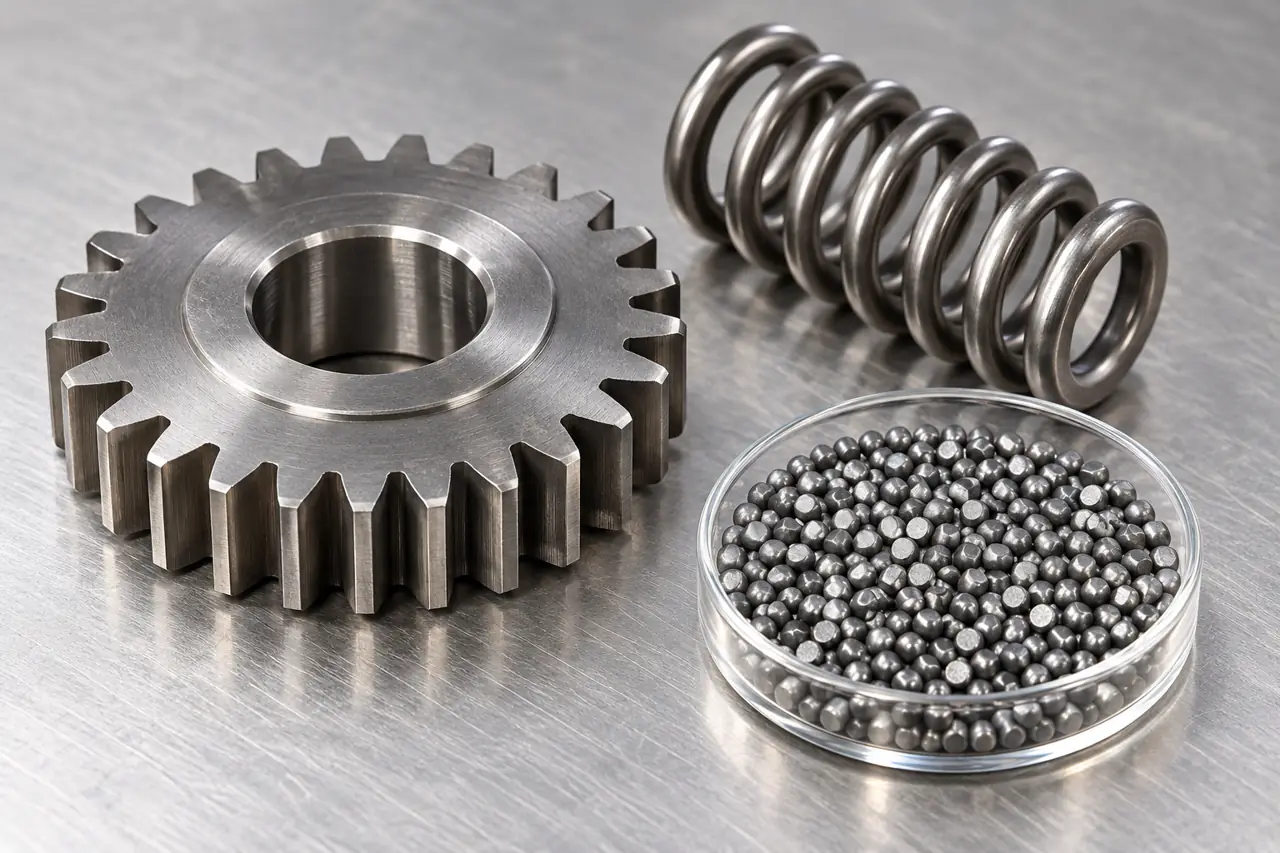
Review exposure at critical features
A gear tooth root, flank and sharp edge do not share identical access to the stream. A spring's inner and outer surfaces also present different geometry. Identify required areas and masking before a candidate trial so the result is judged at the engineering-critical locations.
Check surface condition, dimensional sensitivity and any required downstream treatment separately from intensity and coverage. The spring and gear in the illustration are representative objects only. No fatigue improvement, residual-stress measurement or qualified production treatment is demonstrated by them.
- Gear tooth areasIdentify required roots, flanks and edges with their exposure and protection requirements.
- Spring surface areasReview inner and outer geometry against the actual treated area and access requirement.
- Separate component checksRetain required surface and dimensional assessments alongside the intensity and coverage record.
Operating-media condition must stay within the approved process
Keep new supply and operating media references separate as the particle population changes during use.
Repeated use can change particle distribution and introduce broken or deformed grains. The incoming sample describes the new supply; the in-machine sample describes the media actually reaching the component. Keep those references separate during qualification and replenishment.
Follow the approved process for separation, additions and media checks. If the working population changes, investigate it with delivery settings and equipment condition before attributing a different surface solely to a new supplier. A controlled process baseline is more informative than a fixed catalogue reuse count.
- New supplyBatch and specification identified
- Working sampleUsed population checked separately
- Separation/additionFollow the approved process
- Review driftMedia and equipment considered together
Qualification records should preserve the actual candidate
Connect material conformity evidence with qualification records without merging the decisions they support.
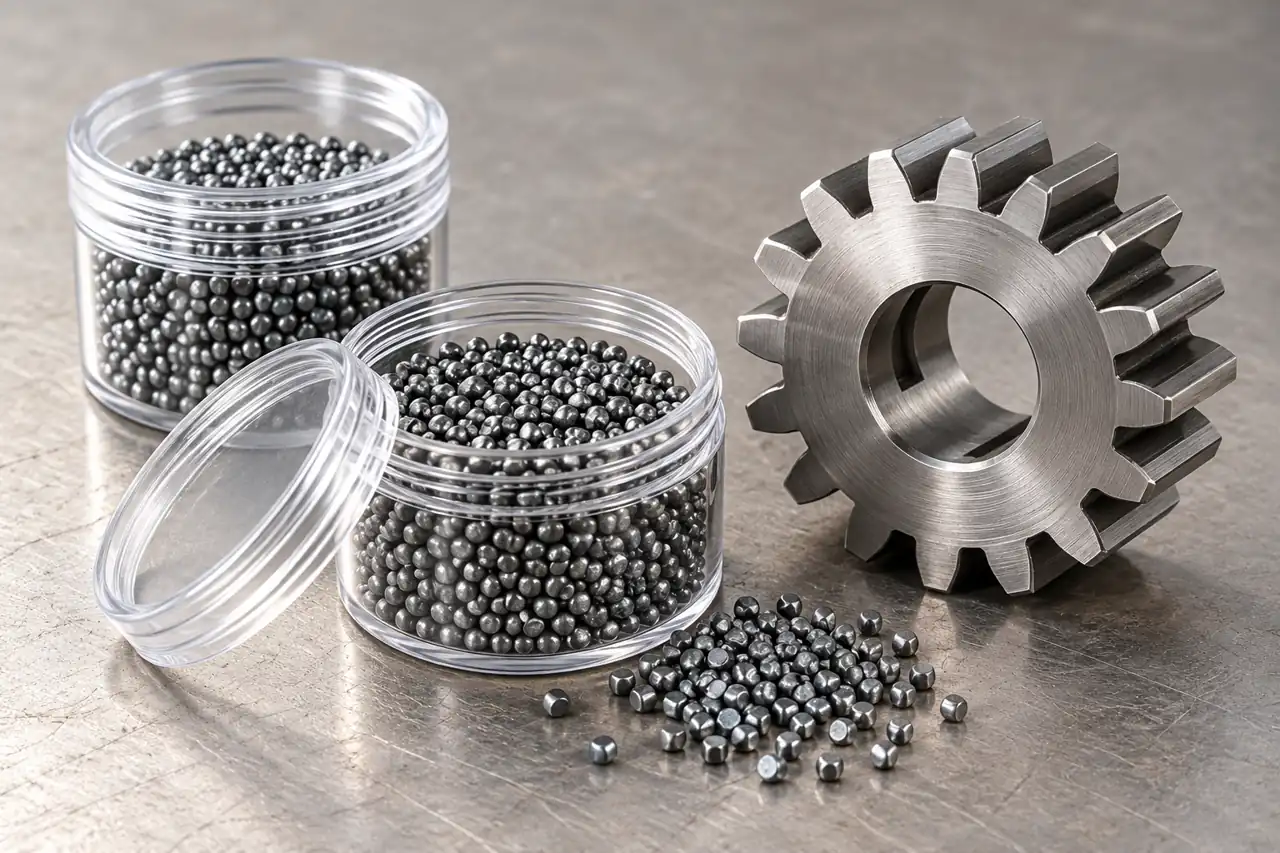
Keep material and treatment records linked
Retain the material identity, offered grading, hardness basis and particle-condition record with the trial samples. For cut wire, keep the selected CW label, diameter and conditioning requirement explicit. The pictured jars and components are AI-assisted retained-reference illustrations rather than certificates.
Connect the supplied batch evidence with the process qualification record without merging their meanings. The first supports media conformity; the second supports the controlled treatment of the named component. Any required fatigue or other component validation belongs in the engineering acceptance plan.
- Candidate identityRetain grading, hardness basis and particle condition with the selected material reference.
- Batch conformityUse the corresponding supplied lot records for the incoming media acceptance characteristics.
- Process qualificationKeep actual component treatment controls and any required engineering validation in their own record.
A supplier change follows the existing qualification boundary
Review a source change against the existing media and process qualification boundary.
Review source, material, size, hardness and particle-condition changes against the approved procedure. Determine which incoming checks and process evidence need repeating before the new supply reaches routine production. Do not treat identical catalogue hardness ranges as complete equivalence.
Carry the approved media revision into repeat orders and preserve the sample reference. Packing must protect identity and condition through receiving, while the responsible process authority controls release for the particular spring or gear duty.
- Describe changeSource, size, hardness or condition
- Review procedureIdentify affected approvals
- Repeat evidenceAs required by the process authority
- Release revisionPreserve approved candidate and scope
Bring the peening specification and media reference
Send the component specification and qualified media reference to define the exact candidate acceptance.
Share the component requirement and the media already qualified for it. We can review the candidate identity and the incoming evidence needed for the proposed supply.
Qingdao Relia Industries Co., Ltd.
Contact address: Shuyuan Road, Qingdao, Shandong, China
- Drawing or process specification revision
- Component material and treated areas
- Current media and particle condition
- Required intensity and coverage basis
- Machine limits and sample acceptance
Enquiry scope and supporting detail
Send the drawing or process specification, component material and critical treated areas, current media identity and required particle condition. Include the specified intensity and coverage basis, machine restrictions, sample purpose and incoming acceptance documents. For the cut-wire candidate, identify the exact CW/diameter pairing and conditioning requirement.
Request a product-specific offer and corresponding batch evidence. Sample arrangements, quantity and commercial schedule are confirmed individually; the supply discussion should remain tied to the qualified process decision your technical team must make.
- Technical briefMaterial · size · particle condition
- QualificationProcess authority · tests · approval scope
- Supply briefTrial quantity · labels · destination