

Low-Carbon Wire Rod for Nail Factories with Drawing Lines
For a nail factory with drawing equipment, choose wire rod around your reduction route and the condition needed at the header. This guide helps you specify grade, section, surface and coils, then trace defects through drawing and nail forming. It also clarifies when the purchase should instead be production-ready drawn wire.
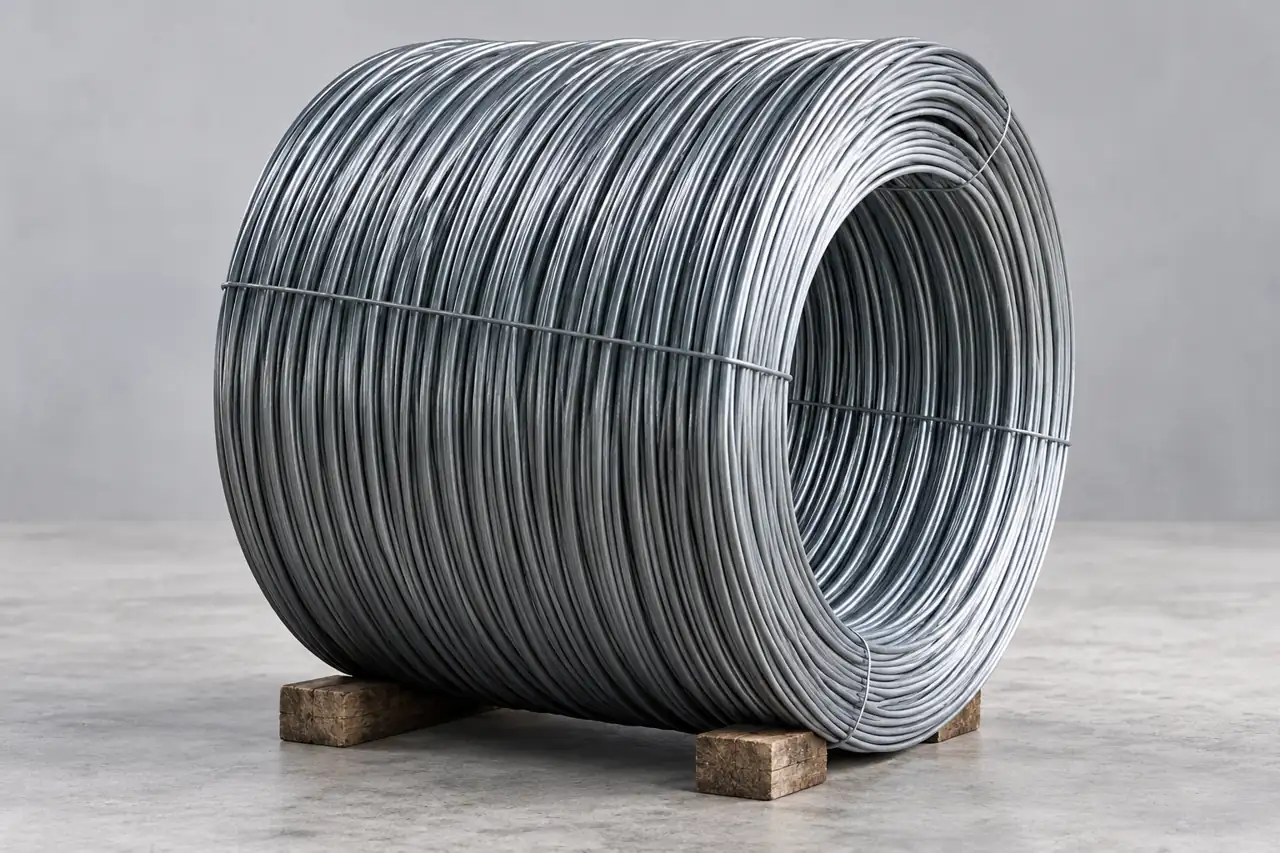
Choose the input your factory still needs to process
For a nail factory with its own drawing line, buy rod by one specified low-carbon grade, actual starting section and surface/coil condition that can be reduced and headed through the intended route. Finished drawn wire and incoming wire rod solve different production needs. Relia manufactures steel wire and can discuss the listed SAE1006B, SAE1008B, Q195 or Q235 rod enquiry with a defined producer and supply scope. Start with rod-to-finished-wire reduction, nail geometry and current breakage or heading defects. Qualify drawing and nail forming together before treating a general nail-making title as proof of line compatibility.
- Starting materialState whether the purchase is rod feedstock or wire ready for nail production.
- Reduction routeIdentify starting section and the final wire condition required after your drawing sequence.
- Forming decisionApprove nail geometry and heading behavior as well as successful wire reduction.
Selection context and decision detail
| Buyer requirement | Relia response | Evidence or condition |
|---|---|---|
| Raw rod for own drawing line | Discuss the listed low-carbon rod supply | One grade, diameter and rod producer required |
| Wire processing | Own drawing, annealing and galvanizing | Receiving stage and remaining buyer operations must be clear |
| Batch and route evidence | Corresponding inspection records available | Drawing and nail-forming trial establish application fit |
Own wire processing and rod supply responsibility must be explicit
Identify the actual rod producer and delivery state separately from the confirmed in-house steel-wire processing operations.
Relia's confirmed wire operations are drawing, annealing and galvanizing. Incoming, in-process and final inspection are performed and corresponding batch records can be provided. For rod feedstock, identify the actual rod producer, grade and delivery state in the offer; our wire manufacture does not establish an unrestricted in-house rod-rolling route.
If the request is instead for finished drawn wire, specify its final diameter, condition and surface separately. The useful evidence follows the product you receive and the work your own factory still performs.
- Rod supplyProducer, grade and delivery state
- Own wire operationsDrawing, annealing and galvanizing
- EvidenceCorresponding batch records and buyer route trial
The rod reference has grades but no populated diameter menu
Select one grade and actual rod section, keeping rod feedstock distinct from the listed finished annealed-wire sizes.
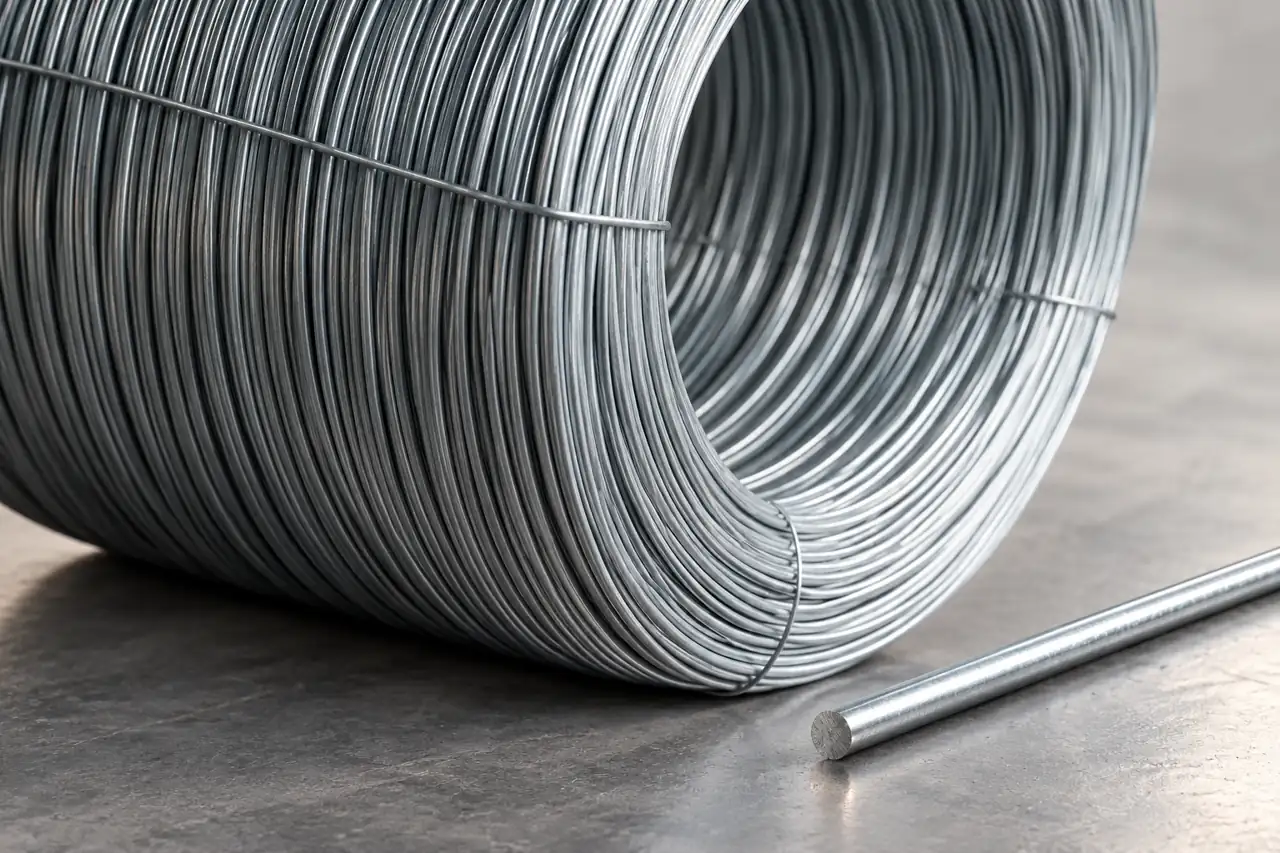
Rod and finished wire are different purchase stages
The nail-making rod listing names SAE1006B, SAE1008B, Q195 and Q235 and identifies coil form. It has no actual diameter options. These grade references should become one selected material basis with chemistry and supplied condition, not a combined chemistry.
The related annealed-wire entry has discrete 1–10 mm choices and broad processing alternatives; it is a different purchasing stage. State actual rod diameter and ovality limits, coil envelope and condition. No title phrase supplies a measured tensile value or confirms every nail-making size.
- Rod feedstockSpecify actual rod diameter, grade and surface for the drawing line in your factory.
- Drawn-wire inputSpecify final diameter and condition when the supplier completes the required wire preparation.
- Coil interfaceDefine the handling envelope and payoff requirements for the product actually received.
Product references for your shortlist
Open the product details, then discuss the exact specification for your application.
Low-carbon rod for drawing and nail trials
A rod enquiry reference for nail factories that reduce a defined low-carbon feedstock before straightening, cutting and heading.
Scale and surface defects affect drawing differently
Investigate scale and inherited surface defects with preparation and die-contact observations before assigning every break to chemistry.
Rod scale must be addressed by the selected preparation route before it becomes an uncontrolled die-contact condition. Scale thickness, cracking and rod roughness affect removal behavior; one preparation setting need not suit every rod source. Longitudinal surface defects also need attention because reduction does not automatically remove them.
Inspect incoming surface and retained samples with drawing observations. Record scale carryover, surface scoring, die condition and break location rather than attributing every line stop to carbon content. Agree relevant limits and records for the actual rod supply.
- Incoming surfaceScale and inherited defects
- PreparationSelected removal and lubrication route
- Drawing observationsScoring, breaks and die condition
- EvidenceRetained material and recorded defect location
Reduction history changes the condition entering the nail header
Record reduction history and final-wire condition because successful drawing alone does not establish suitability for nail heading.
Drawing reduces section and changes strength and remaining ductility. Your pass schedule, lubrication and any intermediate conditioning determine the wire that reaches straightening, cutting and heading. A rod that draws to size can still produce an unsuitable condition for the intended nail head.
Record starting diameter, reduction sequence and final-wire mechanical state. Where annealing is used, identify its role and the properties required afterward. A broad process-family list cannot establish that one supplied rod supports every reduction or heading sequence.
- StartActual rod size and state
- ReducePass schedule and lubrication
- ConditionIntermediate/final treatment where used
- HeadRequired wire state and nail geometry
A nail trial should locate where the failure begins
Retain rod, final wire and formed nails together to locate whether a defect begins in drawing or forming.
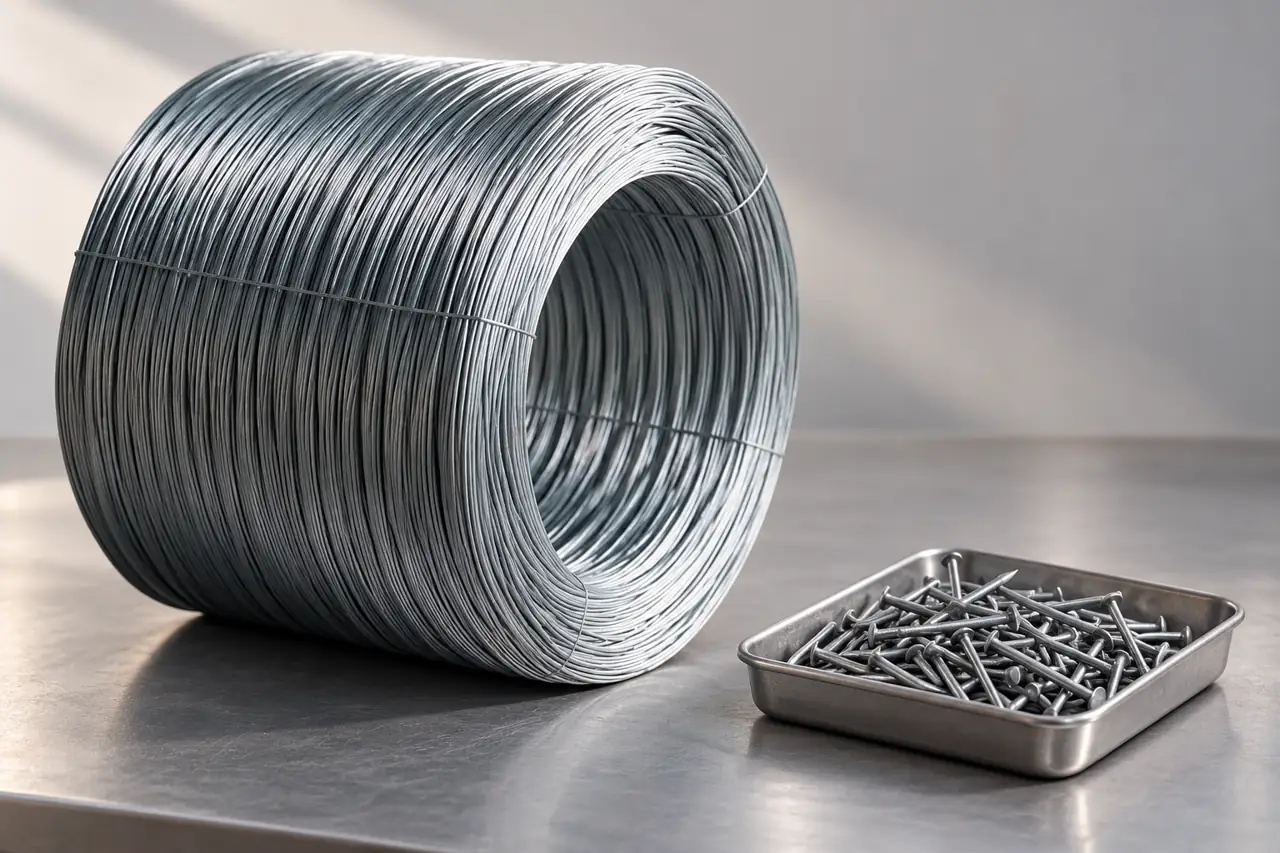
Retain samples at three points in the route
Evaluate representative drawing and nail-forming production. Separate a drawing break from a split head, bent shank or dimensional feed problem. Retain rod, final wire and formed nails under linked references so the defect can be located in the route.
The coil and tray of nails are AI-assisted application illustrations. They do not establish a completed Relia nail-production trial. Actual approval should include the required nail dimensions and forming observations under recorded tooling and material conditions.
- Incoming rodPreserve the supplied section and surface reference associated with the production trial.
- Final wireRecord the reduced section and condition entering straightening, cutting and heading.
- Formed nailLocate split heads, bent shanks or dimensional faults against the recorded material route.
Material and dimensional evidence have different coverage
Use material, geometry and surface evidence for their distinct purposes, connected to the represented lot and trial.
Request composition and any specified mechanical results linked to the represented heat/lot. Measure the actual rod section and relevant ovality using agreed locations and methods. A heat analysis does not prove every coil's geometry or drawing surface condition.
ASTM A510/A510M is a general wire-rod/coarse-wire framework where applicable, not a finished-nail rating. Select the governing grade and product requirements for the order and connect the corresponding batch records with the trial material.
- MaterialSelected grade and represented heat
- GeometryRod diameter/ovality locations
- SurfaceAgreed defects and condition
- ApplicationDrawing and nail-forming result
Coil handling should preserve feedstock quality
Match coil handling and payoff requirements while preserving turns, surface condition and source identity.
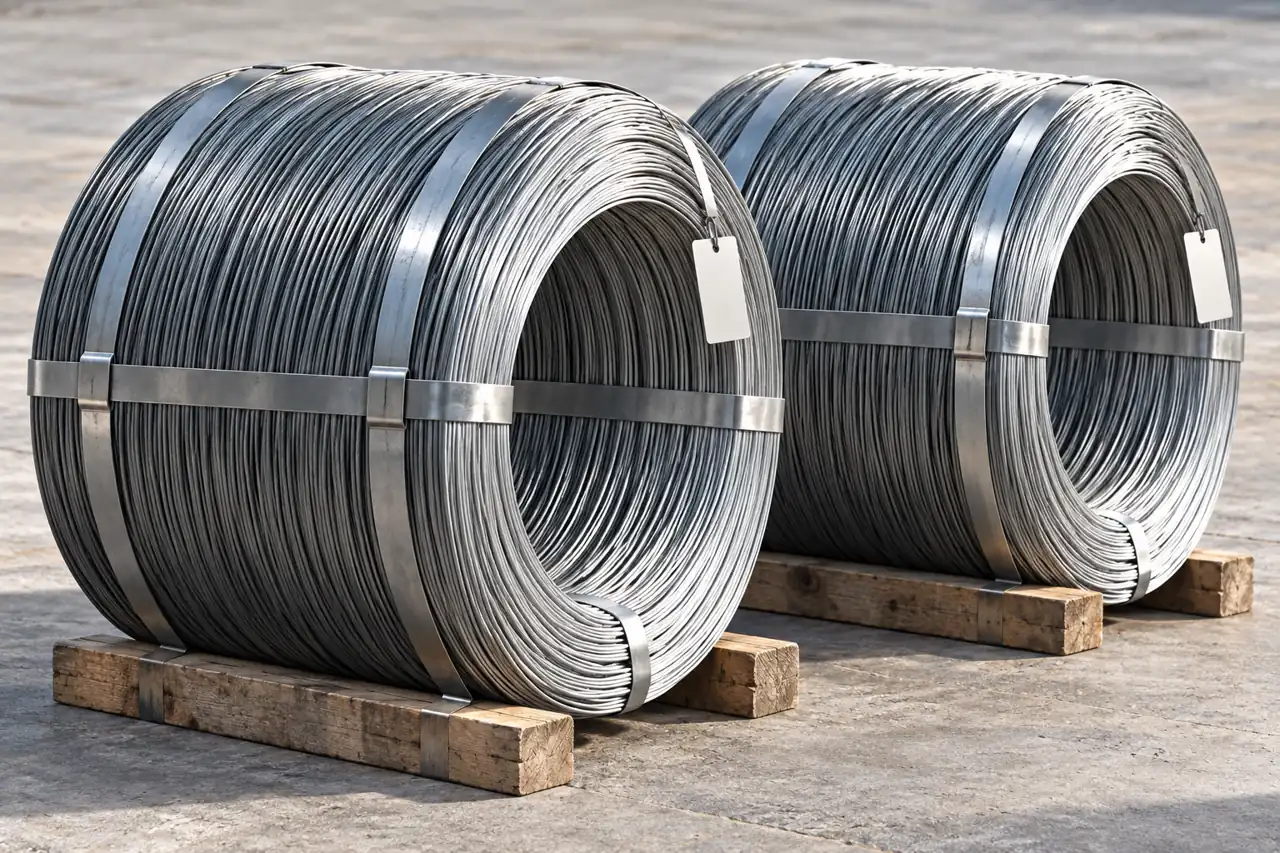
Protect rod condition and payoff
Specify coil opening, outside envelope, unit mass and unloading/payoff constraints. Keep coils supported and identified, and protect against handling damage and moisture appropriate to the route. Distorted turns can disrupt feeding even when the material analysis matches.
The separate tagged coils are AI-assisted packing references. They do not establish an actual mill lot, weight or export shipment. Confirm the agreed pack and marking scheme in the offer and preserve heat/lot identity during receiving.
- Handling envelopeSpecify coil opening, outside dimensions and mass limits for unloading and feed equipment.
- Coil conditionPrevent distorted turns and record moisture or handling damage before production release.
- Source identityKeep the grade and heat or lot reference connected to the received coil.
Useful yield follows both drawing and forming
Compare accepted nails with drawing breaks, heading rejects and material use across the same production route.
Compare accepted final nails, wire breaks, heading rejects and material used across the same route. A lower rod price can be offset by die wear, surface preparation or scrap downstream. Keep those observations alongside final-wire size and condition.
For replenishment, retain the approved grade, rod section, surface, coil arrangement and trial baseline. Review a producer or condition change before using an unchanged machine setup as the acceptance test.
- BaselineRod and production route
- TrialAccepted nails and scrap types
- CompareMaterial, preparation and die consequences
- RepeatPreserve approved source and condition
Describe the rod-to-nail route
Send the rod-to-nail sequence and final requirements to define the correct feedstock and a representative production trial.
Send the drawing and nail-forming sequence with actual defect references so we can discuss rod identity, coil requirements and evidence for a meaningful production comparison.
Qingdao Relia Industries Co., Ltd.
Contact address: Shuyuan Road, Qingdao, Shandong, China
- Selected grade and rod diameter
- Surface preparation and drawing reductions
- Final wire and nail dimensions
- Coil handling and payoff envelope
- Breakage samples and trial criteria
Enquiry scope and supporting detail
Send the required grade, rod diameter/limits, coil handling envelope and surface-preparation method. Add the intended drawing reductions, final wire size, nail drawing and heading route, with actual breakage or defect samples if available. State the material records and production-trial criteria that govern approval.
Request a defined rod offer and identify whether you want raw rod or production-ready drawn wire. Include quantity and destination; producer, availability, samples and commercial schedule require confirmation for that selected supply.
- MaterialGrade basis, rod size and supplied condition
- ProcessDrawing route and nail-production requirements
- OrderTrial quantity, coil limits and destination