

Glass-Bead Supply for Mould Maintenance and Finishing
For mould maintenance, choose glass beads around the residue to remove and the features you must preserve. This guide helps you define the bead grading, protect critical surfaces and test a representative insert. You will also learn how broken beads and recycling conditions can change a finish that previously worked.
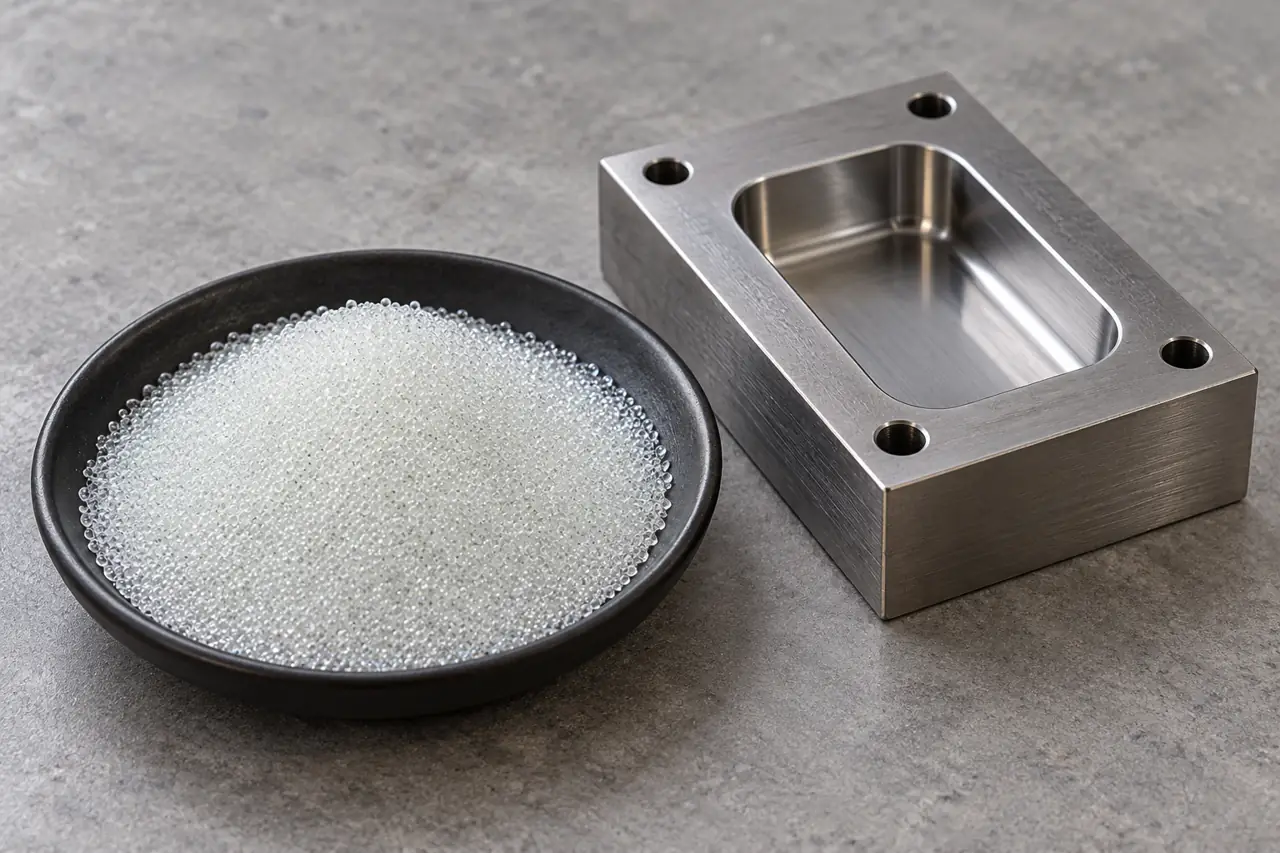
Start with the mould maintenance objective
For mould maintenance that needs controlled residue removal and a repeatable texture, consider a defined glass-bead grade only where the mould material, coating and critical features tolerate the impact. Round-bead finishing and angular abrasive cutting are different actions; neither a clean photograph nor a broad mesh range guarantees preservation of a polished cavity or edge. Relia supplies the listed glass-bead enquiry and can discuss its actual grading and inspection scope. Start with the residue, mould material, protected features and desired finish, then run a representative trial with recorded pressure, angle, distance and exposure before approving routine maintenance use.
- Residue removalIdentify the deposit and starting surface before choosing a bead treatment.
- Protected featuresMark polished cavities, sealing lands and fine details excluded from treatment.
- Accepted finishDefine allowed texture and geometry changes for the actual mould surface.
Selection context and decision detail
| Buyer requirement | Relia response | Evidence or condition |
|---|---|---|
| Controlled mould maintenance | Discuss the listed glass-bead candidate | Material, coating and protected features govern suitability |
| Defined particle supply | Resolve grading, roundness and integrity | 12#–325# and 12#–320# fields need reconciliation |
| Evidence and trial | Corresponding batch records can be provided | Actual insert and recorded process conditions required |
Glass beads have a separate supply and evidence route
Identify the glass-bead producer and particle evidence independently from the confirmed cast-steel abrasive manufacturing route.
Relia's confirmed self-manufactured abrasives are cast steel shot and grit, with in-house melting, atomization, heat treatment and grading. Glass beads are a separate listed supply item; their producer and material/particle evidence must be identified for the offer.
We perform incoming, in-process and final inspection and can provide corresponding batch records. Agree the scope relevant to the chosen glass supply, including distribution, roundness and integrity requirements and any additional testing. Our cast-steel route does not establish glass manufacture or a certified mould-finishing process.
- Company routeOwn cast steel shot/grit production
- Glass supplySelected producer and particle identity
- InspectionCorresponding records and required tests agreed
The two range endpoints need one agreed grading
Agree one grading convention and delivered distribution instead of treating range endpoints as a selected grade.
The catalogue grit option reads 12#–325#, while the specification option reads 12#–320#. Its body describes round glass beads and Mohs hardness 7. These are enquiry references, not a selected distribution or batch roundness result.
Name the grading convention, delivered sieve fractions and permitted particle condition for the actual order. Do not silently convert the endpoints or assume every size combination is available. A hardness reference alone does not establish bead survival, surface roughness or compatibility with the mould material and coating.
- Grit option12#–325#
- Specification option12#–320#
- Order gradingNamed convention and sieve fractions
- ConditionRoundness/integrity requirement
Product references for your shortlist
Open the product details, then discuss the exact specification for your application.
Glass beads for mould trials
A round-media candidate for a defined mould cleaning or texture trial where critical features and finish limits are controlled.
Bead condition changes contact with the mould surface
Round beads and fractured fragments make different contacts, so examine the working charge as well as new supply.
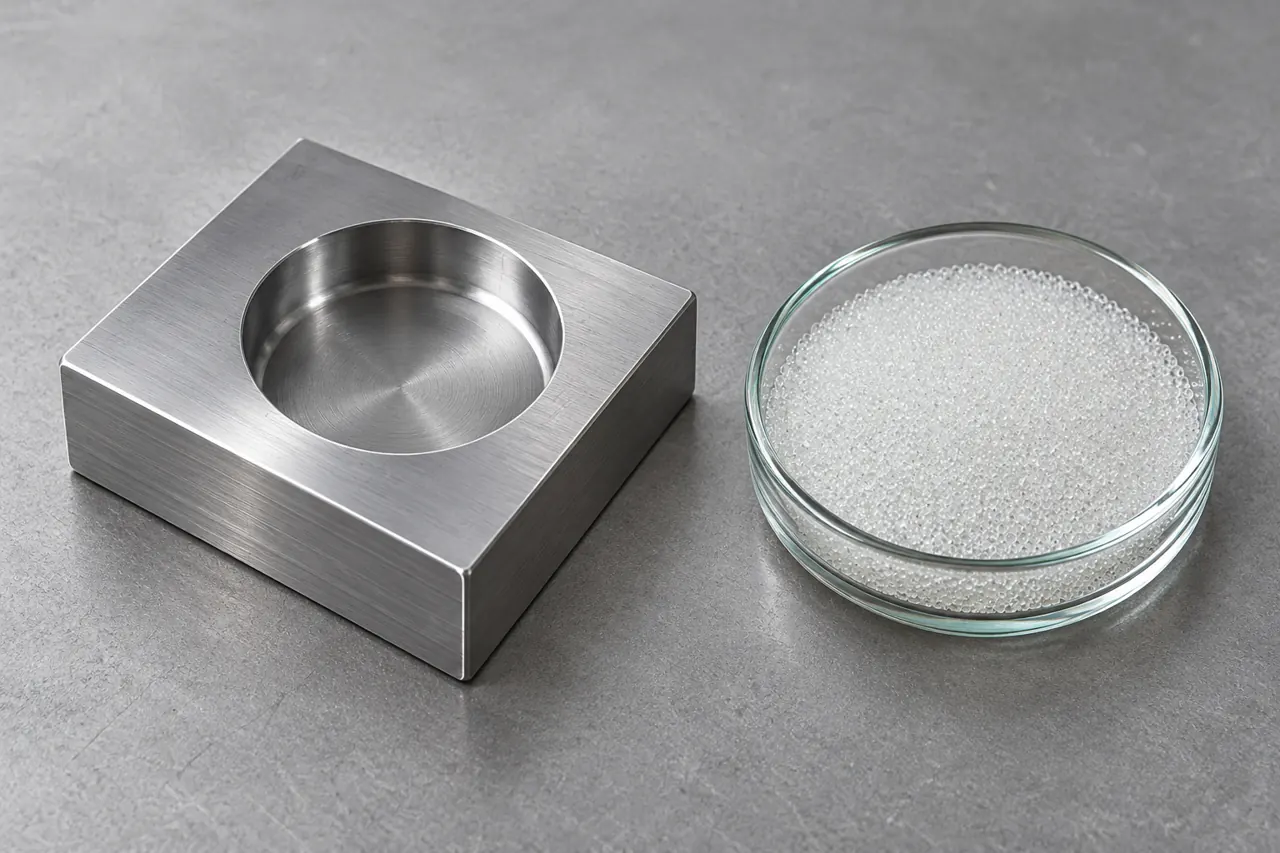
New beads and working media need separate checks
A round bead contacts the surface differently from a fractured angular fragment. Repeated impact and broken particles can alter the texture generated by the charge. In a recirculating cabinet, the new-bag specification therefore needs to be considered separately from the operating mix.
Review the actual distribution and particle integrity with the delivery settings. Select screens and recovery practice within the equipment maker's procedure. The bead and mould illustration explains the contact objects; it does not demonstrate a damage-free treatment or prove that the cavity retains its original finish.
- New supplyReview the delivered distribution and particle integrity against the selected grading.
- Recycled chargeInspect broken particles and fines that can change contact with the mould.
- Delivery conditionsRecord pressure, angle, distance and exposure beside the observed surface result.
Cleaning and texture need different acceptance limits
Set separate acceptance for residue, texture and critical geometry, with excluded mould surfaces clearly marked.
Identify whether the maintenance task concerns release-agent residue, oxidation, deposits or a cosmetic change. Some contamination requires precleaning; extra blasting can create unwanted texture without solving the cause. Protect sealing lands, fine vents, engravings, shut-offs and any surface excluded by the mould drawing.
Agree what may change and where. A visual residue criterion is different from roughness or dimensional acceptance. If the cavity must retain a polished functional surface, assess whether bead blasting is appropriate before selecting a grade.
- Identify residueCleaning task and starting condition
- ProtectExcluded surfaces and critical features
- TreatRecorded media and delivery conditions
- AssessResidue, finish and geometry separately
A representative insert reveals local risks
Trial representative edges and recesses under recorded conditions rather than approving every mould from a flat coupon.
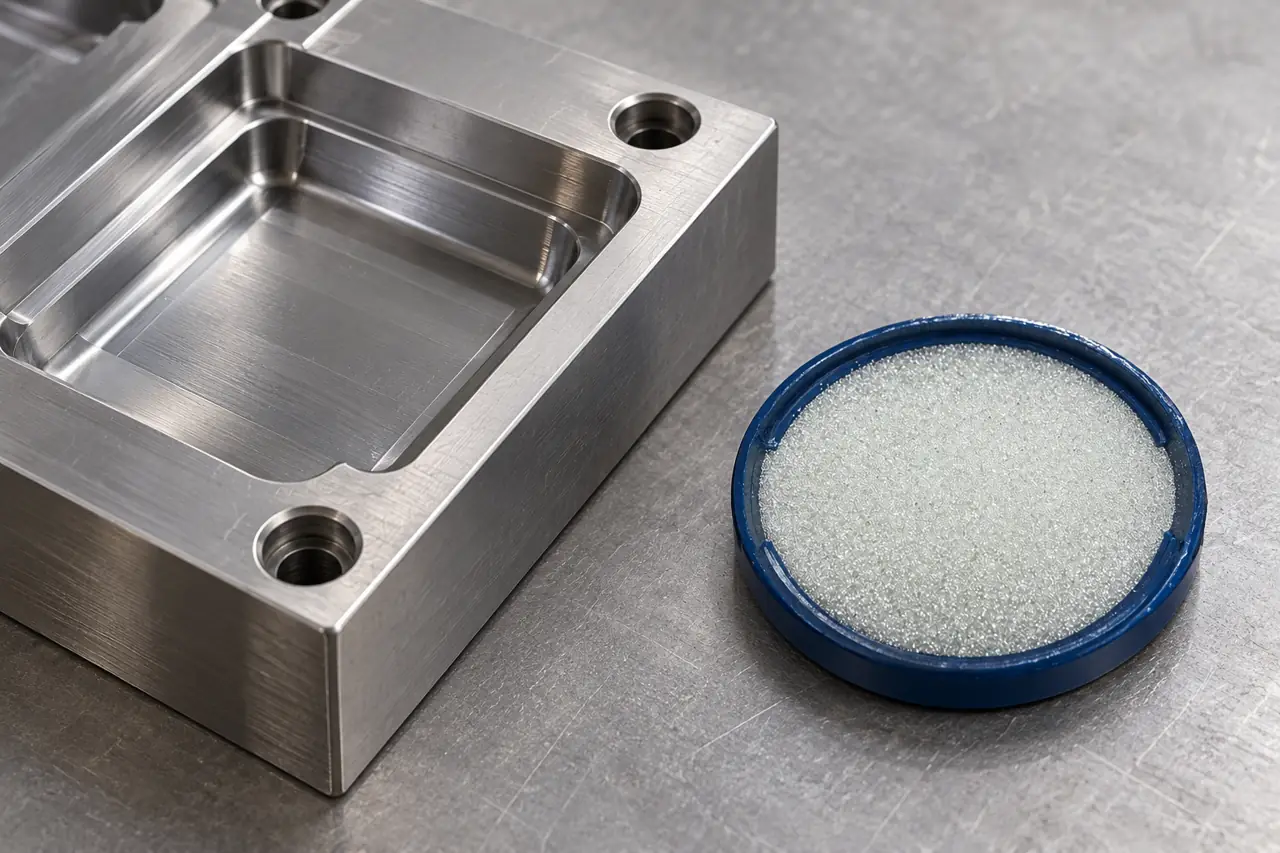
Use a representative insert to establish the result
Trial a representative insert or approved test area with the relevant hardness, coating and geometry. Record starting residue, media condition, pressure, angle, distance and exposure. Inspect edges and recessed features as well as the visible flat face.
Compare the required finish by the agreed method and measure critical geometry where needed. The illustrated machined insert and beads are AI-assisted references, not a production before-and-after example. Do not approve every mould in the shop from one favorable flat coupon.
- Record the startIdentify insert material, coating, residue and the features needing close inspection.
- Run the trialApply the recorded bead condition and delivery settings to the approved area.
- Assess local featuresCompare finish and critical dimensions at edges, recesses and flat faces.
Operating mix and recovery can explain finish drift
Investigate finish drift through bead breakage, contamination, feed and recovery before changing several process variables.
A finish that becomes rougher or patchier may reflect broken beads, changed distribution, contamination, feed variation or access. Retain new supply, working media and discarded material separately when investigating. A fresh refill cannot be compared fairly with an old charge without recording that difference.
Record media additions, accepted maintenance work and rework under comparable conditions. A fixed reuse-life claim is not supplied by the listing. Use the observed charge behavior and equipment limits to define replenishment and cleaning practice.
- New bagSupplied distribution and particle condition
- Working chargeBreakage, fines and contamination
- DeliveryFeed and process settings
- ResultLocation-specific finish and rework
Retained samples keep the supply investigation specific
Connect the retained bead batch to the actual insert trial and location of any surface change.
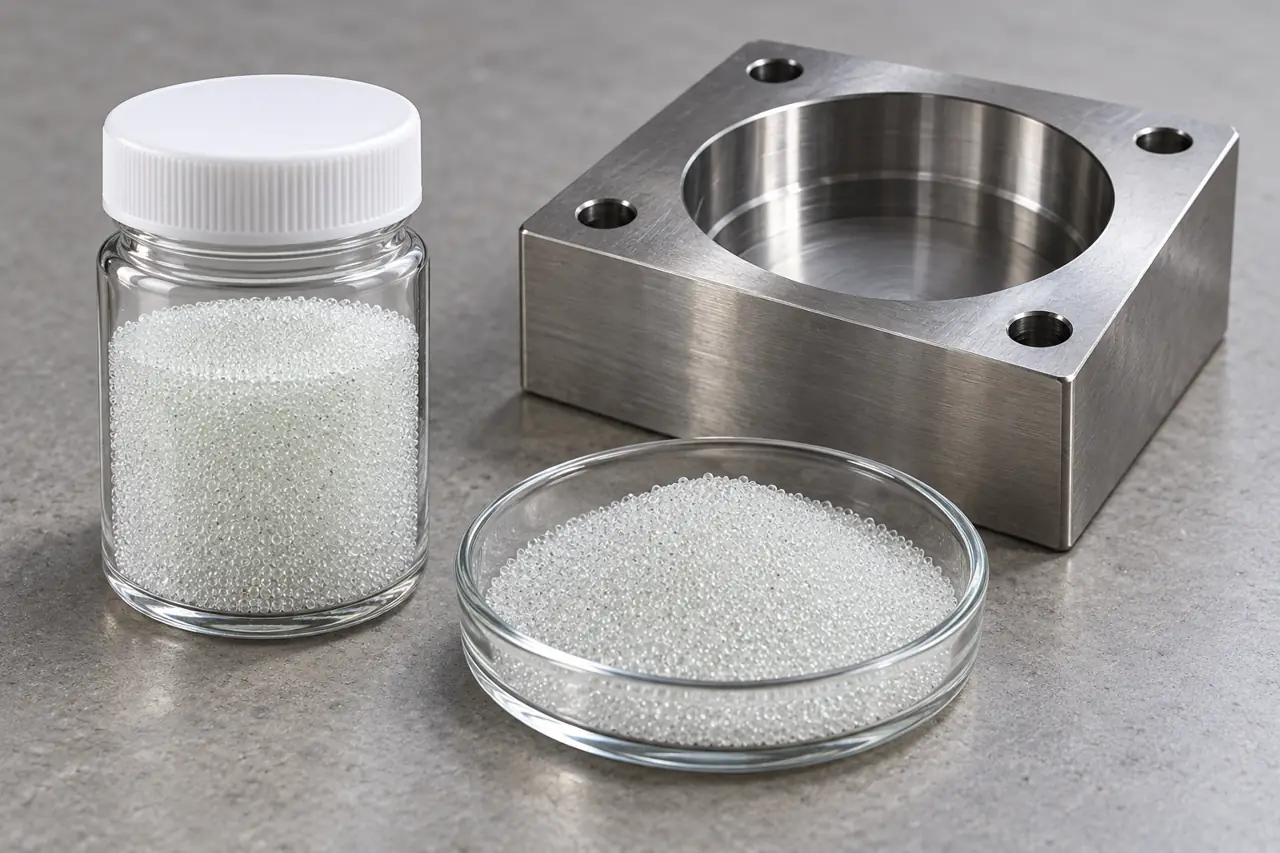
Keep supply evidence connected to surface evidence
Link the glass-bead batch, selected grading and relevant records with the insert trial. Preserve the actual failed surface or photographs, including the feature and observed texture change. A jar of clean beads cannot by itself show what reached the mould after recycling.
The image shows a separate retained bead reference beside a mould insert. It does not establish purity, density, chemical analysis or a certified particle-quality result. Request those characteristics only where the selected specification and maintenance task require them.
- Bead referenceRetain the selected grading and batch represented in the actual maintenance trial.
- Surface referenceLocate texture changes with photographs and the retained insert where practical.
- Working chargeKeep recycled media separate so investigation reflects what actually reached the mould.
Storage and repeat orders preserve the approved media identity
Keep the approved distribution identified and clean, and review changes in supplier or mould surface.
Keep beads dry, identified and protected from incompatible shop material. Use appropriate separate handling where contamination restrictions apply. Maintain the approved distribution and particle condition rather than replacing by the words glass beads alone.
Review a change of supplier, grading or mould material against the original trial. A new alloy or coated cavity can respond differently to an unchanged bead. Packing, sample arrangements and current supply quantities should be confirmed for the actual order.
- RetainApproved grade and trial
- StoreDry, clean and identified
- ReplenishPreserve population and condition
- ReviewSupplier or mould-surface change
Describe the mould maintenance task
Send the residue, protected features and finish limits so the proposed grading can be tested meaningfully.
Share the mould surface, residue and protected features so we can discuss a selected bead grade and a representative insert trial.
Qingdao Relia Industries Co., Ltd.
Contact address: Shuyuan Road, Qingdao, Shandong, China
- Mould alloy and surface coating
- Residue and protected feature photographs
- Required finish and dimensional limits
- Cabinet settings and working media
- Trial quantity and destination
Enquiry scope and supporting detail
Send the mould material, surface/coating condition, residue description and drawing or photographs marking protected areas. Add the current cabinet and media, allowed process envelope and desired cleaning/finish criteria. Request a selected grading that resolves the catalogue endpoints and corresponding batch evidence.
Include the representative insert or trial-area plan, quantity, packing and destination. We can discuss a defined glass-bead offer and the test needed to establish suitability for that maintenance duty.
- Mould briefMaterial · features · starting condition
- Finish briefVisual reference · dimensional limits
- Supply briefMedia requirement · sample · packing