

Finishing Media Trials for Aluminium Die Castings
For aluminium die castings, choose finishing media against the texture, burr and protected-feature limits of the real housing. This guide helps you compare zinc and stainless cut-wire candidates in separate trials, check residual media and contamination, and retain enough evidence to repeat a successful finish without damaging critical bores, threads or sealing lands.
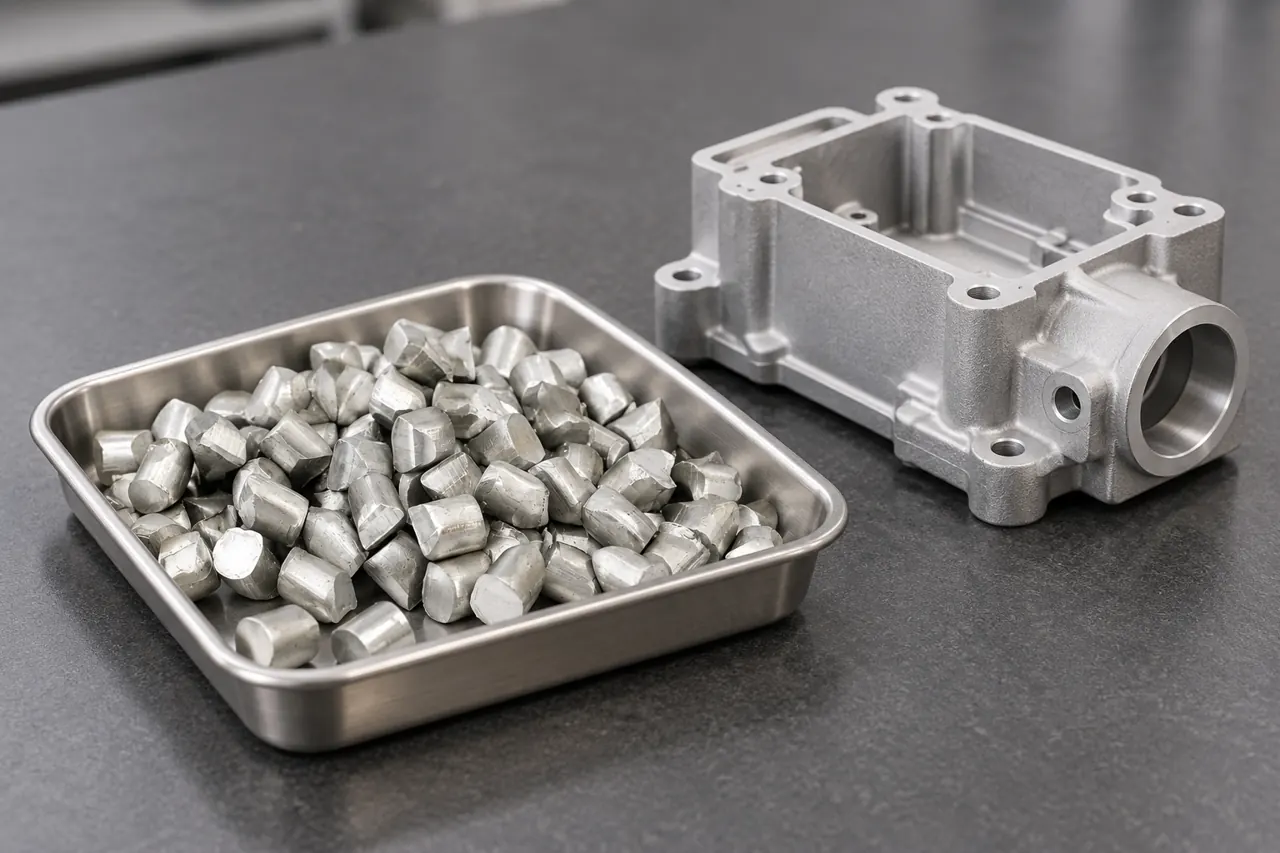
Define the finishing boundary before choosing media
For aluminum die-casting finishing, compare a zinc cut-wire candidate with a separately defined stainless candidate only against the surface texture, contamination and feature limits your housing must meet. Select actual alloy, particle condition and grading before tuning exposure. Relia supplies the listed zinc and stainless cut-wire enquiries; its confirmed cast-steel abrasive manufacture does not establish these cutting or conditioning routes in-house. Start with a representative casting, protected sealing lands, bores and threads, and a recorded baseline. Approve cosmetic appearance separately from burr removal, residual media and dimensional change before committing to repeat media supply.
- Cosmetic resultProvide the texture reference for the faces that determine the accepted appearance.
- Protected featuresMark sealing lands, bores and threads where damage or residual media matters.
- Separate candidatesSelect an identified zinc or stainless grade and particle condition for each trial.
Selection context and decision detail
| Buyer requirement | Relia response | Evidence or condition |
|---|---|---|
| Controlled casting finish | Compare listed zinc and stainless candidates | Actual alloy, particle condition and protected geometry required |
| Defined supply role | Review individual cut-wire supply routes | Cast-shot manufacture does not establish cut-wire operations |
| Batch and trial evidence | Corresponding inspection records can be provided | Appearance, burrs, dimensions and contamination checked separately |
The two cut-wire candidates need individual supply identities
Define each cut-wire material and its cutting or conditioning responsibility separately from the confirmed cast-steel abrasive route.
Relia manufactures cast steel shot and grit through its confirmed in-house cast route and manufactures steel wire. Zinc and stainless cut-wire are distinct supply candidates on this page. Their actual material producer, cutting/conditioning route and selected particle condition must be stated in the offer.
Incoming, process and final inspection are performed and corresponding batch records can be provided. Match the relevant record scope to the selected zinc or stainless supply, including required material, grading and particle evidence, rather than assuming one cast-steel route explains every media family.
- Own manufactureSteel wire and cast steel shot/grit
- Cut-wire offerIndividual material and producer route
- EvidenceCorresponding inspection records and selected tests
Zinc and stainless catalogue fields require different clarification
Confirm actual chemistry and particle condition, keeping zinc and stainless hardness references on their own measurement scales.
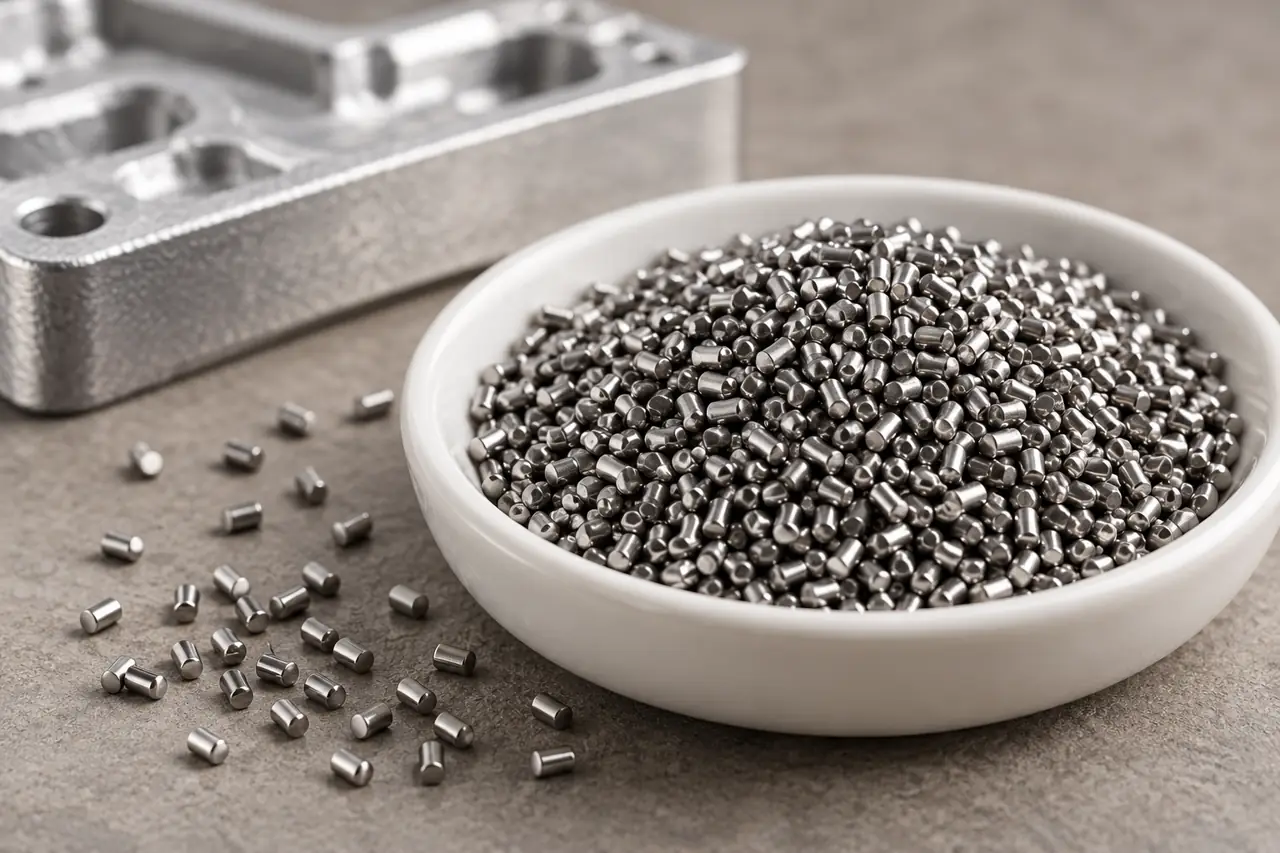
Treat zinc and stainless as separate candidates
The zinc listing selects Zinc with a 1.2 mm specification and a 0.6–2.5 mm grit reference. It describes minimum 99.995% purity and 40–50 HV, while retaining a Steel raw-material field. Confirm selected-batch chemistry and form.
The stainless entry covers 0.2–2.0 mm and gives a round field without conditioning records. Its 35–50 HRC reference uses a different scale from the zinc value; do not compare the numbers as one hardness measure. The AI-assisted cut-faced particle image does not establish conditioned-round stainless media.
- Zinc candidateConfirm selected chemistry, actual size and particle form for the proposed zinc sample.
- Stainless candidateDefine the stainless alloy and conditioning evidence for the selected particle population.
- Comparable evidenceUse the appropriate hardness basis and a recorded casting trial for each material.
Product references for your shortlist
Open the product details, then discuss the exact specification for your application.
Zinc cut-wire trial candidate
A zinc-media enquiry reference for a separately controlled aluminium finishing trial with defined particle and surface acceptance.
Stainless cut-wire trial candidate
A separate stainless-media enquiry route when the selected alloy and particle condition fit the casting’s finishing constraints.
Contact action changes texture and vulnerable features
Particle geometry and delivery energy influence texture and damage, so compare candidates without changing several variables together.
Metallic particles can indent the aluminum surface as they remove light residue. Size, material, particle geometry and delivered energy change that action. A cylindrical as-cut particle has contact faces and edges that differ from conditioned geometry. An acceptable flat face can coexist with a rounded edge or damaged thread.
Specify the supplied condition and grade with the machine's permitted media. Treat the two candidates as separate trials; changing alloy, size and settings simultaneously can conceal which factor produced the result.
- MaterialZinc or specified stainless alloy
- ParticleAs-cut or defined conditioned form
- DeliveryMachine-compatible size and energy
- ResultTexture, damage and dimensional acceptance
Residual burrs and a cosmetic texture are separate tasks
Map the burr root and access path separately from cosmetic texture and protected feature acceptance.
A thin burr at an accessible edge may respond differently from a heavy attached burr or material inside a blind feature. More aggressive blasting can damage the housing without solving a blocked burr root. Map the actual burr, access path and excluded surfaces before the trial.
Keep machining or other deburring needs visible where blasting cannot meet the requirement. Define the desired texture, burr acceptance and dimensions separately rather than accepting a uniformly bright housing as proof of every finishing result.
- Cosmetic faceTexture against agreed reference
- Burr rootLocation and removal criterion
- Critical featureDimensions and protected areas
- RecessAccess and residual-media inspection
Representative castings expose the comparison limits
Inspect representative ribs, bores, threads and recesses as well as the visible face during the casting trial.
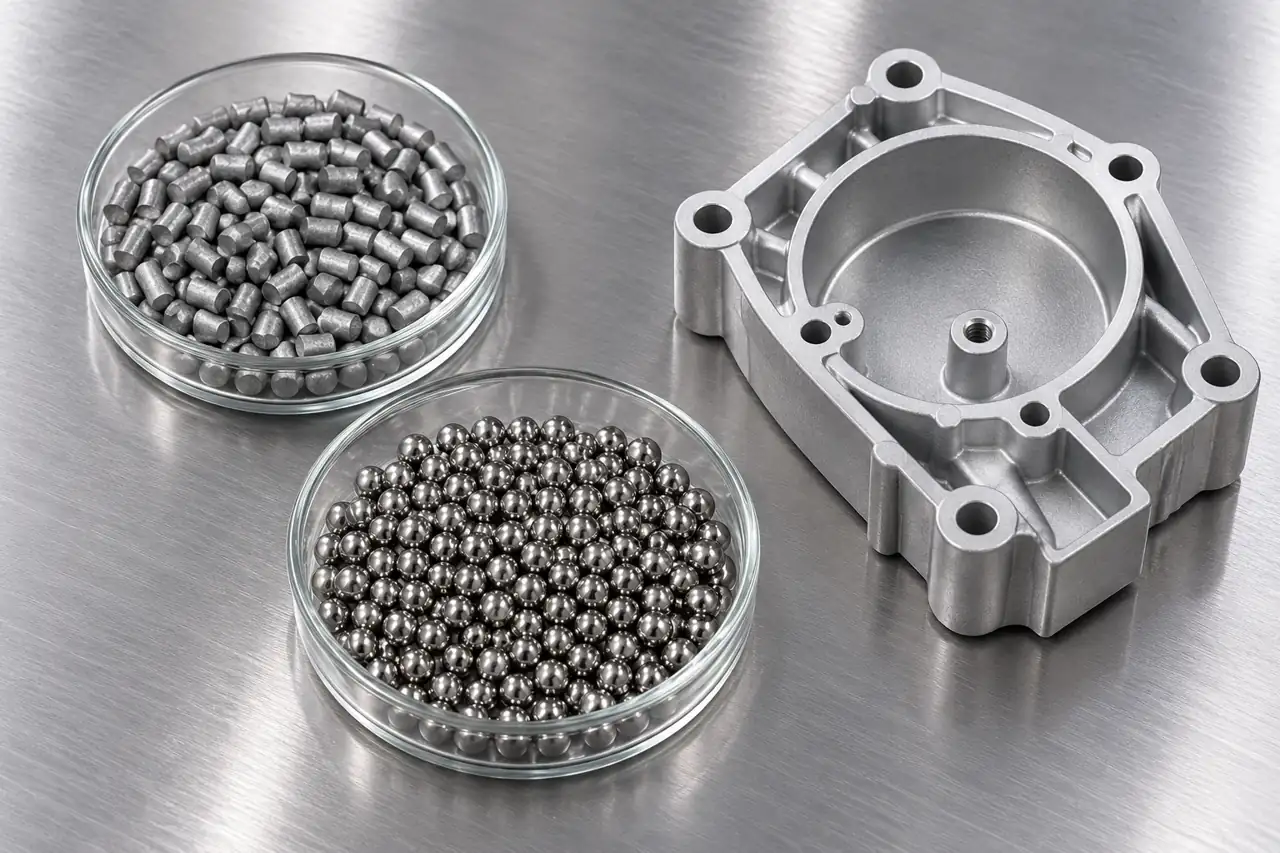
Inspect beyond the visible casting face
Use comparable alloy, casting condition and geometry for baseline and candidate. Record media identity, operating mix, loading, orientation and settings. Inspect ribs, sealing lands, bores, threads and recesses as well as the cosmetic panel.
The separate media dishes and housing are illustrative, not measured before-and-after parts. An observed texture should be assessed against the agreed reference, while dimensional readings and residual-media checks establish different acceptance points. A flat coupon alone does not approve the full housing family.
- Representative castingUse comparable alloy and geometry with the actual machine and loading conditions.
- Critical featuresInspect ribs, sealing lands, bores, threads and recesses against the drawing limits.
- Separate outcomesAssess texture, dimensional change and residual media as distinct trial acceptance results.
Contamination control follows the whole handling route
Control the full recovery and handling route because correct bulk media chemistry cannot establish the finished surface condition.
Previous media, fixtures, scoops and recovery equipment can introduce foreign material even when the selected media alloy is correct. Review cleanout or segregation for the actual surface restriction, then protect the casting after treatment.
Where contamination or a subsequent coating process is critical, specify the applicable surface assessment. Bulk media chemistry does not measure what remains on the finished casting. Neither zinc purity wording nor a stainless family name guarantees a contamination-free result through an unexamined machine route.
- SupplyActual media chemistry
- MachinePrevious charge and recovery path
- HandlingFixtures, scoops and transfer
- Finished partRequired surface contamination result
Retain the media and casting evidence separately
Retain incoming media, working charge and accepted casting references separately while connecting them through the trial record.
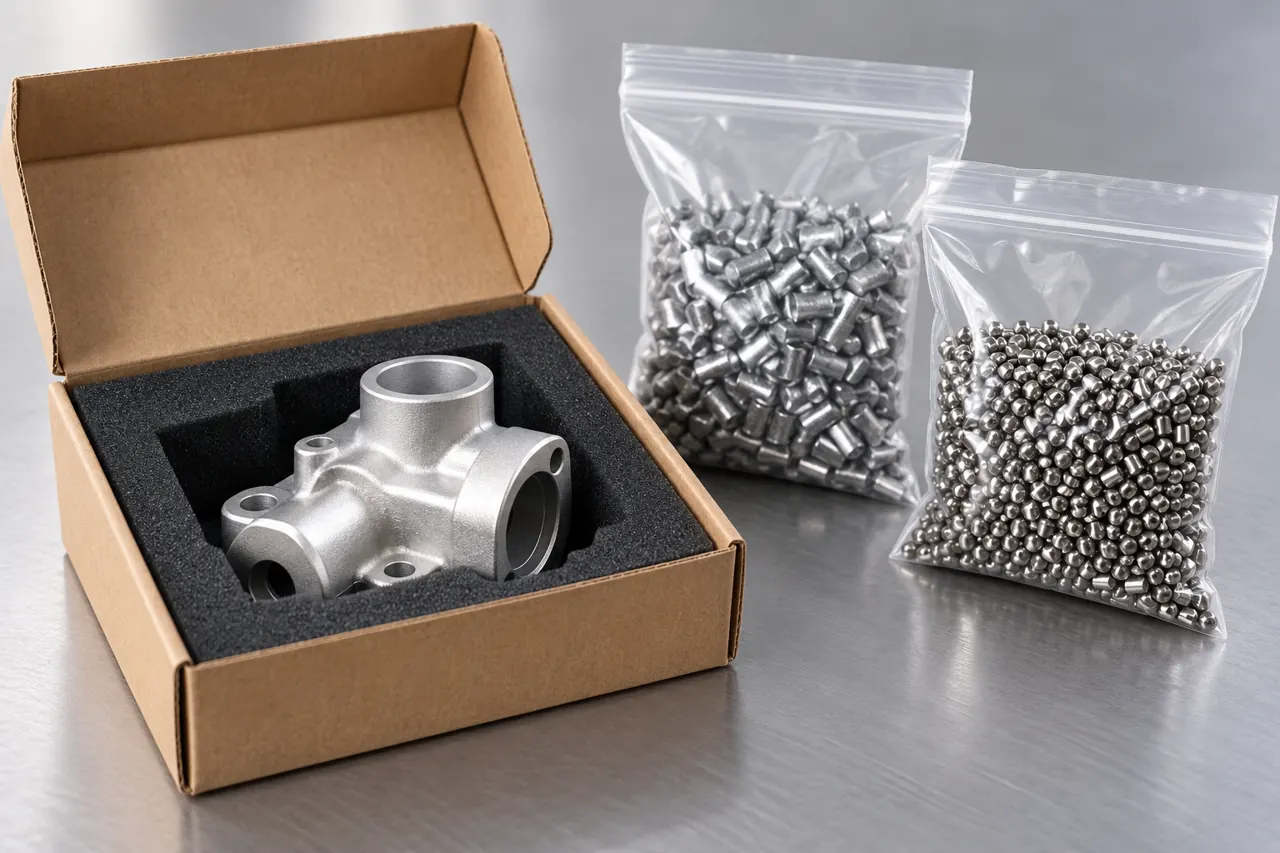
Retain the inputs and accepted result separately
Keep unopened media samples, working-charge samples and the accepted casting or inspection reference distinct. Link them through the supplied lot and recorded trial. This allows a later texture or staining change to be compared with actual incoming material and handling conditions.
The protected component and two plain media bags are AI-assisted illustrations. Their appearance does not verify alloy, conditioning or a customer packing service. Request the corresponding batch records and preserve the real measurements needed for your acceptance decision.
- Incoming sampleKeep unopened media evidence tied to the supplied material and batch reference.
- Working chargeRetain recycled media separately to show the condition that reached the casting.
- Casting referencePreserve the accepted part or inspection reference with the recorded trial conditions.
Replenishment follows the approved candidate and charge condition
Replenish the approved material and particle condition, reviewing source changes and the actual recycled-charge behavior.
Use the selected material, particle geometry, distribution and accepted trial as the repeat-order baseline. Review changes in producer, conditioning or grading before treating a new bag as equivalent. A recycled charge also changes through wear and contamination, so an incoming result does not describe the hopper by itself.
Track accepted castings, rework and media additions under comparable conditions. The catalogue reuse figures do not supply a controlled life or a lower-cost guarantee for the die-casting line.
- Approved mediaMaterial, form and grading
- Working mixWear/contamination sampled separately
- Useful outputAccepted parts and rework
- Change reviewProducer or conditioning difference
Define the casting and finishing limits
Send the casting, finish boundary and contamination restrictions so the proposed media comparison addresses the real acceptance decision.
Send a representative housing and its finish boundaries so we can discuss the selected media candidate, particle evidence and a comparison that protects critical features.
Qingdao Relia Industries Co., Ltd.
Contact address: Shuyuan Road, Qingdao, Shandong, China
- Casting alloy and drawing revision
- Cosmetic reference and burr locations
- Protected bores threads and dimensions
- Machine media and contamination restrictions
- Trial quantity and acceptance methods
Enquiry scope and supporting detail
Send the casting alloy and drawing, cosmetic reference, burr locations and protected dimensions. Add the current media and machine, contamination restrictions, downstream process and trial acceptance methods. Identify the exact zinc or stainless candidate and any required conditioning.
Request a coherent material offer, relevant batch records and a representative sample comparison. Include quantity, packing and destination; sample arrangements, commercial terms and schedule require confirmation for the actual selected supply.
- PartAlloy, drawing and difficult features
- TrialEquipment, candidate media and acceptance method
- OrderQuantity, destination and required batch records